
Gold IRA Scams: 5 Red Flags Regulators Warn About (2026)
In 2024, the CFTC, FINRA, and the North American Securities Administrators Association launched a joint effort to warn retirees about precious metals fraud. This guide turns their warnings into five red flags you can spot on a single phone call, with the questions to ask and where to report a Gold IRA scam.
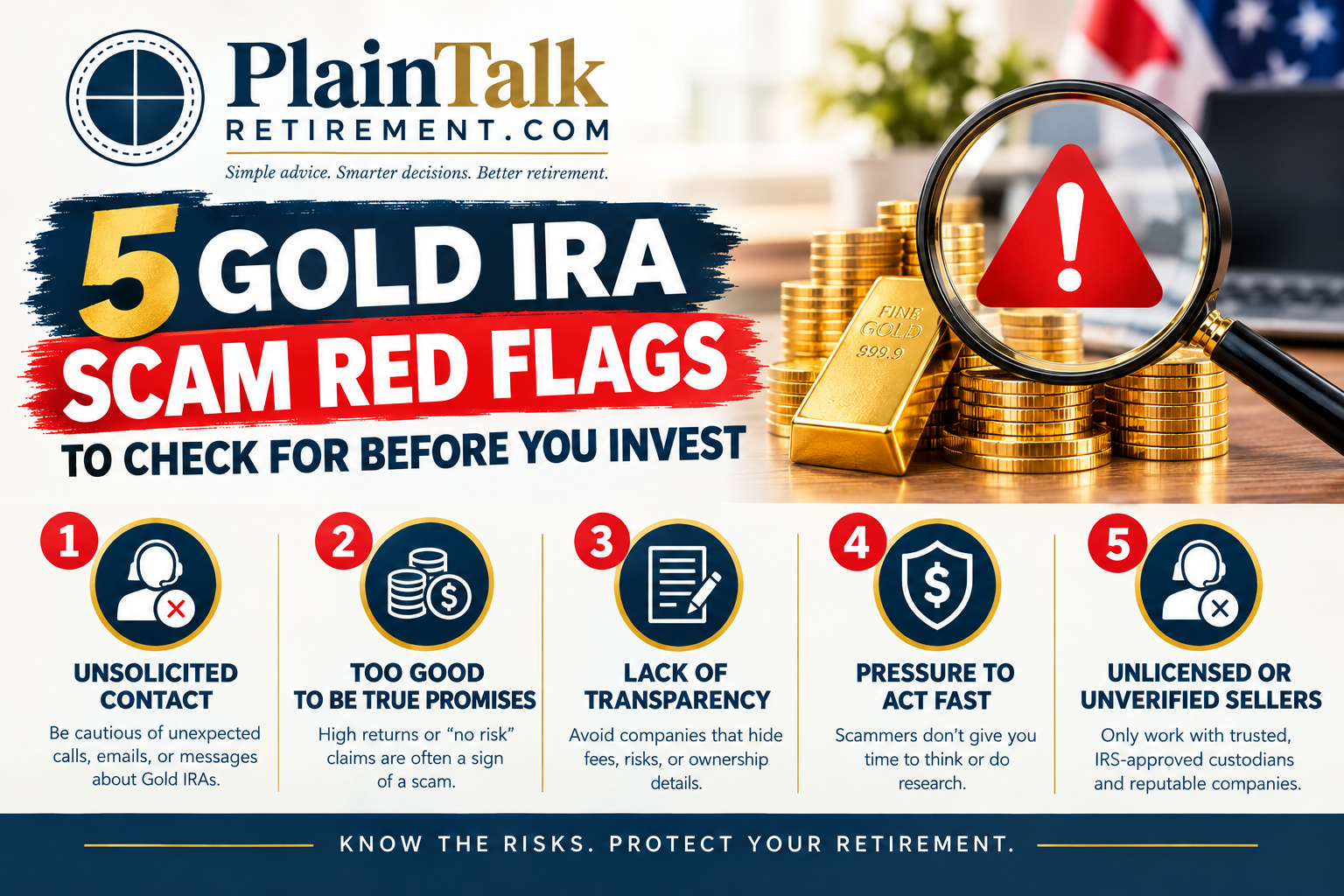
The 5 biggest Gold IRA scam red flags
- They called you, and they want a decision fast.
- Huge markups, often hidden in “collectible” or “semi-numismatic” coins.
- Storage you can’t verify, including any home storage pitch.
- Fees that aren’t in writing before you sign.
- An “expert” you can’t look up, or trust borrowed from a celebrity or cause.
Based on the CFTC and FINRA bulletin “10 Things to Ask Before Buying Physical Gold, Silver, or Other Metals.”
Red flag 1: They contacted you, and they want a decision now
“Gold is about to take off. This price won’t last past today.”
The CFTC’s first piece of advice is blunt: never respond to cold calls, unsolicited emails, junk mail, late-night infomercials, social media posts, or pop-up dealers. Its fraud page describes high-pressure salespeople who have pushed “thousands of unsuspecting investors,” and traveling dealers working out of hotel rooms or insisting on home visits.
Urgency is often paired with fear: warnings of an economic collapse and the claim that you have to move your savings before it’s too late. Gold trades on world markets every business day. A real opportunity doesn’t disappear in an hour.
What to do: Hang up on unsolicited pitches. If you’re interested in gold, you start the conversation, on your schedule, with a company you’ve looked up first.
Source: CFTC, Precious Metal Frauds
Red flag 2: Huge markups, often hidden in “rare” coins
“These semi-numismatic coins are a better investment than plain bullion.”
The spread is the gap between what a dealer charges you and what the metal is worth at the spot price. The CFTC warns that scam dealers charge spreads of 30 to 300 percent or more, plus ongoing fees. At those levels, the metal would have to rise enormously just for you to break even.
The most common hiding place is collectible coins. The CFTC calls “semi-numismatic” “a made-up industry term.” Collectible coins carry higher markups than bullion, are much less liquid when you sell, and many don’t qualify for an IRA at all.
What to do: Ask for the spot price and the price you’ll pay for each product, in writing. Then ask why standard bullion isn’t the recommendation.
Source: CFTC/FINRA, 10 Things to Ask
Red flag 3: Storage you can’t verify, including home storage
“You can keep your IRA gold at home. It’s perfectly legal.”
It isn’t. IRC Section 408(m) requires bullion held in an IRA to be in the physical possession of a qualified trustee, which in practice means an IRS-approved depository. Home storage and “checkbook LLC” arrangements can cause the IRS to treat the metal as distributed, with taxes and penalties to follow.
The opposite trick is just as dangerous. The CFTC describes dealers who charged customers extra to store bullion in far-away vaults that didn’t exist, and fees charged for metal that never existed at all.
What to do: Get the depository’s name in writing, confirm it independently, and make sure your custodian’s statements show your holdings there.
Sources: IRC 408(m); CFTC, Precious Metal Frauds
Red flag 4: Fees that aren’t in writing before you sign
“Don’t worry about the paperwork, we’ll go over the costs after you’re set up.”
The CFTC’s instruction is explicit: ask for all fees, costs, commissions, and the agreed retail price in writing before signing. That includes storage, insurance, and administrative fees, and it means asking what price the dealer will pay if you sell back.
The stakes are real. In one case the CFTC describes, a $300,000 retirement rollover generated about $150,000 in commissions and fees. In its words, the costs are often “so high that buyers never see a profit.”
What to do: No itemized fee schedule, no purchase. A legitimate company will put every number on paper before you commit a dollar. Our Gold IRA fees guide shows what normal fees look like.
Source: CFTC/FINRA, 10 Things to Ask
Red flag 5: “Experts” you can’t look up, and borrowed trust
“I’m an IRA expert, and people like us have to stick together.”
The CFTC warns that scam dealers pose as “IRA experts” or advisors, and that telemarketers often have no real expertise. Anyone giving investment advice must be registered with the SEC, FINRA, or a state regulator, and you can check.
Scam dealers also build trust they haven’t earned. The CFTC notes they deliberately advertise on political and religious programming, and some steal the images of well-known personalities to fake endorsements.
What to do: Look up the salesperson and the company before your second conversation. Shared values are not a credential. See the lookup tools below.
Source: CFTC, Lies Versus Facts
5 lies Gold IRA scam dealers tell, and the facts
The CFTC published these in its guide “Lies Versus Facts: The Truth Behind Gold and Silver IRA Scams.” If you hear one, end the call.
“Putting all your retirement savings in precious metals is safe and secure.”
Spreads of 30 to 300 percent or more, plus fees, and prices that can be as volatile as any commodity. Diversification is safer than concentration.
“You can trust us because we share your political or religious views.”
Scam dealers target ideological programming on purpose, and some fake endorsements with stolen images of well-known people.
“The government can’t seize collectible coins.”
Collectible coins have no special federal protection. The claim is fear marketing to rush a purchase of high-markup coins.
“There are secret tax loopholes in owning precious metals.”
Only specific bullion qualifies for an IRA, and there are no secrets to rollovers. Self-directed IRAs have complex rules and higher fees.
“You’re talking to an expert advisor with inside information.”
Telemarketers often lack expertise. Anyone giving investment advice must be registered, and you can verify it.
Your Gold IRA pre-purchase checklist
Adapted from the CFTC and FINRA’s “10 Things to Ask.” Don’t sign anything until you can check every box.
- I started the conversation. Not a cold call, email, or pop-up dealer.
- I know today’s spot price and the exact price I’m paying over it, per product.
- I’m buying standard IRA-eligible bullion, or I understand why a collectible coin costs more.
- I have every fee in writing: setup, custodian, storage, insurance, and commissions.
- I know the buyback price the dealer would pay today, and whether a fee applies.
- I have the depository’s name, and it’s IRS-approved. No home storage.
- I looked up the salesperson and company with a regulator and the BBB.
- No one is rushing me. I can take the paperwork home and decide next week.
How to check a Gold IRA company before you buy
These are the free lookup tools regulators point to. It takes about ten minutes.
Also read the company’s Better Business Bureau profile, especially the complaints and how the company answered them.
What a legitimate Gold IRA company looks like
| Check | Legitimate company | Red flag |
|---|---|---|
| First contact | You reach out when you’re ready | Cold call, spam email, or pop-up dealer |
| Timeline | Education first, decide on your schedule | “Today only” pricing, fear of collapse |
| Products | IRA-eligible bullion, price over spot disclosed | “Semi-numismatic” or “rare” coins pushed hard |
| Fees | Itemized in writing before you sign | “We’ll cover costs later” |
| Storage | Named, IRS-approved depository | Home storage or an unnamed vault |
| Buyback | Explained honestly, no guaranteed price | Promised profits or guaranteed prices |
| Track record | Years of checkable BBB and regulator history | Little or no history you can verify |
How to report a Gold IRA scam
If a pitch doesn’t sit right, report it. Each agency covers a different part of the problem, so it’s fine to report to more than one.
None of this means Gold IRAs are a scam. Precious metals can be a legitimate part of a diversified retirement plan, and established companies use IRS-approved depositories and put fees in writing. The red flags describe specific tactics, not the whole industry.
Gold IRA scams: frequently asked questions
What are the biggest Gold IRA scam red flags?
Based on CFTC and FINRA guidance, the biggest red flags are unsolicited contact and pressure to buy quickly, being steered toward collectible or semi-numismatic coins with large markups, home storage or storage you can’t verify, fees that aren’t given to you in writing before you sign, and salespeople who claim expertise or borrow trust but can’t be verified with a regulator.
How much do Gold IRA scammers mark up metals?
The CFTC warns that dealers can charge spreads of 30 to 300 percent or more above or below the spot price, plus ongoing fees. In one case the CFTC describes, a $300,000 rollover generated about $150,000 in commissions and fees. Costs that high can mean a buyer never sees a profit.
Is home storage of Gold IRA metals legal?
No. Under Internal Revenue Code Section 408(m), bullion held in an IRA must be in the physical possession of a qualified trustee, which in practice means an IRS-approved depository. Keeping IRA metals at home can be treated as a distribution, which can mean taxes and penalties.
What does semi-numismatic mean?
The CFTC calls semi-numismatic a made-up industry term. It is often used to sell coins at collectible prices. Collectible coins generally carry higher markups than bullion, are less liquid, and many do not qualify for an IRA at all.
Can the government seize bullion but not collectible coins?
The CFTC lists this as a lie used by scam dealers. Collectible coins have no special federal protection and are treated like any other asset. The claim is usually paired with fear about an economic collapse to push a fast purchase.
How can I check whether a gold salesperson is legitimate?
Anyone giving investment advice must be registered with the SEC, FINRA, or a state regulator. You can search FINRA BrokerCheck, the SEC’s Investment Adviser Public Disclosure site, and the NFA’s BASIC database, contact your state securities regulator, and read the company’s Better Business Bureau complaint history.
What should I get in writing before buying gold for an IRA?
The CFTC says to ask for all fees, costs, commissions, and the agreed retail price in writing before signing anything, and to ask what price the dealer will pay if you sell the metal back. Also get the custodian’s fees, the storage fee, and the name of the depository.
Who do Gold IRA scams target?
The CFTC says gold and silver IRA frauds frequently target older workers and retirees, often through self-directed IRAs. Scam dealers also advertise on political or religious programming and use fake celebrity endorsements to build trust.
Where do I report a Gold IRA scam?
You can file a tip or complaint with the CFTC at cftc.gov/complaint, send a tip to FINRA, report to the FTC at reportfraud.ftc.gov, and contact your state securities regulator or attorney general.
Are all Gold IRA companies scams?
No. Precious metals can be a legitimate part of a diversified retirement portfolio, and established companies use IRS-approved depositories and put their fees in writing. The red flags on this page describe specific tactics to avoid, not the whole industry.
Sources: CFTC and FINRA, 10 Things to Ask Before Buying Physical Gold, Silver, or Other Metals; CFTC, Lies Versus Facts: The Truth Behind Gold and Silver IRA Scams; CFTC, Precious Metal Frauds; CFTC press release 8881-24 (March 2024 joint effort with FINRA and NASAA); 26 U.S.C. 408(m). Written by Michael Lehman for Plain Talk Retirement; checked September 2026.
Hold any Gold IRA company to these standards
If you’re moving $50,000 or more, Augusta Precious Metals is the company we recommend. Here’s how it lines up with the checklist above:
- You request the guide; the education session comes before any purchase
- Salaried, non-commissioned educators (per Augusta)
- Storage at an IRS-approved depository, never at home
- A+ with the BBB since 2015, in business since 2012
- States plainly that no buyback can be guaranteed
For people moving $50,000 or more. Ask for every fee in writing, as you should with any company.
Read our Augusta review or compare the best Gold IRA companies.