
IRA Eligible Gold: IRS-Approved Coins and Bars
IRA eligible gold is gold bullion that is at least 99.5% pure and is held by your IRA custodian, not by you. The one well-known exception is the American Gold Eagle, which is 91.67% gold but is named in the tax code. Silver must be 99.9% pure, and platinum and palladium 99.95%. Krugerrands, pre-1933 U.S. coins and rare collectible coins do not qualify. Eligible does not mean fairly priced, and that part matters as much as the purity rule.
What makes gold IRA eligible
The tax code treats metals and coins as collectibles, and an IRA is not allowed to buy collectibles. Section 408(m) then carves out an exception for two things:
- Certain U.S. coins named in the law: American Eagle gold coins in one, one-half, one-quarter and one-tenth ounce sizes, one-ounce American Silver Eagles, and certain platinum coins.
- Bullion that meets a purity standard: gold, silver, platinum or palladium at or above the fineness that a regulated futures contract requires for delivery. In practice that means 99.5% for gold, 99.9% for silver and 99.95% for platinum and palladium.
There is one more condition, and it is the one people miss: the metal has to be in the physical possession of the IRA trustee or custodian.
So the phrase "IRS-approved coins" is a little loose. The IRS does not keep a list of approved products. The law names a few coins and sets a purity test, and custodians decide which products they will accept under it. Always confirm a specific coin with your custodian before you buy.
Sources: IRS Publication 590-B, Investment in Collectibles; 26 U.S.C. 408(m); CME Group, COMEX gold futures rulebook (delivery fineness).
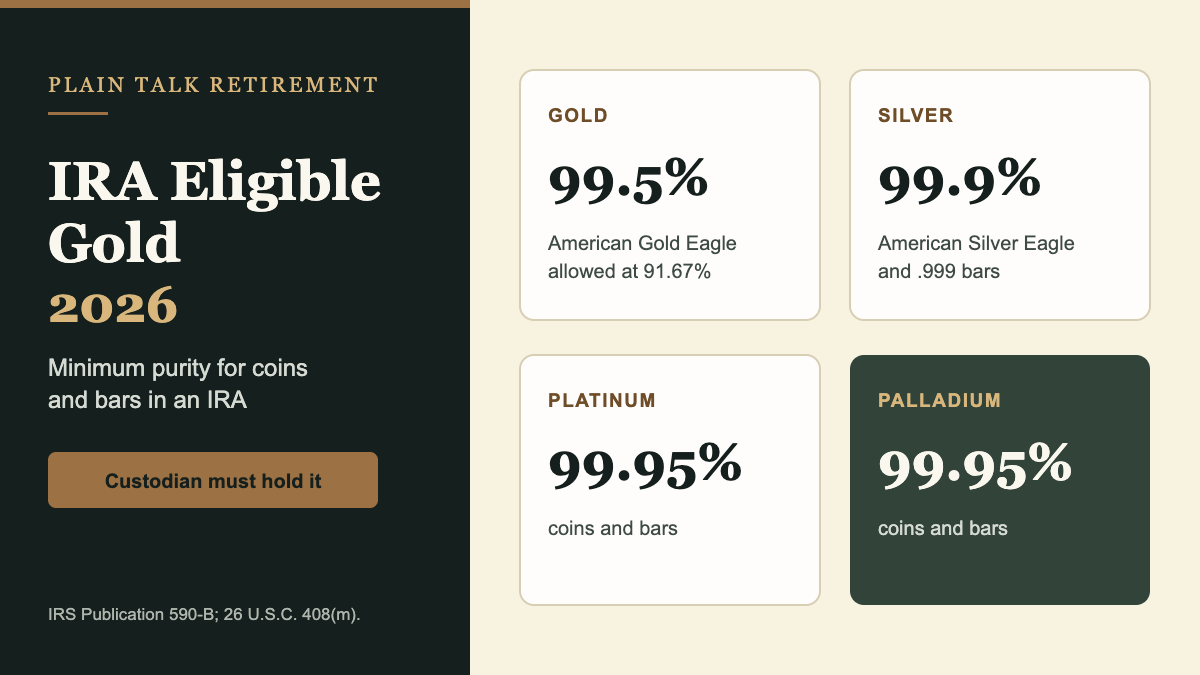
IRA eligible gold coins and bars, plus silver, platinum and palladium
These are products that meet the purity standard and are widely accepted by IRA custodians. It is not a complete list, and acceptance is the custodian's call.
| Metal | Minimum purity | Commonly accepted coins | Bars |
|---|---|---|---|
| Gold | 99.5% | American Gold Eagle (91.67%, named in the law), American Gold Buffalo, Canadian Gold Maple Leaf, Austrian Gold Philharmonic, Australian Gold Kangaroo | 99.5% or higher, from a recognized refiner or mint |
| Silver | 99.9% | American Silver Eagle, Canadian Silver Maple Leaf, Austrian Silver Philharmonic | 99.9% or higher |
| Platinum | 99.95% | American Platinum Eagle, Canadian Platinum Maple Leaf | 99.95% or higher |
| Palladium | 99.95% | Canadian Palladium Maple Leaf | 99.95% or higher |
Proof versions of American Eagle coins are generally accepted too, but they carry higher premiums than the standard bullion coins.
Sources: IRS Publication 590-B; 26 U.S.C. 408(m)(3). Purity figures for individual coins are from the issuing mints.
Gold that is not IRA eligible
| Product | Why not |
|---|---|
| South African Krugerrand | 91.67% gold, below the 99.5% standard, and not named in the tax code |
| British Gold Sovereign | 91.67% gold, below the standard |
| Pre-1933 U.S. gold coins (for example, Double Eagles) | About 90% gold; sold as collectibles |
| Rare, graded or numismatic coins | Coins are collectibles under the tax code unless they fit the bullion exception |
| Jewelry and gold you already own | An IRA cannot buy collectibles, and you cannot contribute metal you already hold |
What happens if an IRA buys something that does not qualify: the IRS treats the amount invested as distributed to you in the year of the purchase. You owe income tax on it, and may owe the 10% additional tax on early distributions.
Eligible gold still has to be held by the custodian
Buying the right coin is half the rule. IRS Publication 590-B says the coins must be in the possession of the IRA's custodian or trustee, and that if the owner takes possession, they are treated as distributed. In practice the custodian has the metal shipped to a depository and you never handle it.
That is why "home storage gold IRA" pitches are a red flag. Our gold IRA storage guide covers depositories and costs, and best gold IRA custodians covers who holds the account.
Source: IRS Publication 590-B.
IRA eligible does not mean fairly priced
Eligibility is a tax rule. It says nothing about what a coin should cost. Two eligible one-ounce gold coins can be sold at very different prices over the spot value of the metal, and the difference goes to the dealer.
The clearest example is the Red Rock Secured case. According to the CFTC, the firm steered retirement savers away from common bullion and into a coin it presented as a premium product, with undisclosed markups of about 92% to 130%. A federal court ordered about $39 million in restitution in 2024.
How to protect yourself: stick to widely traded bullion coins and bars, and ask for the price of each coin next to the spot price, in writing. If a salesperson pushes an "exclusive" or "limited" coin, ask what the same weight in a standard coin would cost.
More on this in gold IRA scams and red flags, gold IRA free silver offers and gold IRA fees.
Which metals each company offers
Not every dealer sells all four metals. Augusta Precious Metals offers gold and silver only. Birch Gold Group and Noble Gold Investments offer gold, silver, platinum and palladium. If you want platinum or palladium in the account, that narrows the list. Minimums differ as well; see gold IRA minimum investment.
Sources: Augusta Precious Metals, FAQ. Full write-up: Augusta Precious Metals review. All six companies: Best Gold IRA Companies of 2026.
IRA eligible gold: frequently asked questions
What gold is IRA eligible?
Gold bullion that is at least 99.5% pure and held by the IRA custodian or trustee. That covers bars from recognized refiners and coins such as the American Gold Buffalo and Canadian Gold Maple Leaf. The American Gold Eagle is 91.67% gold but is allowed because the tax code names it.
Does the IRS approve specific gold coins?
Not coin by coin. The tax code names American Eagle coins and sets a purity standard for bullion. IRS Publication 590-B says an IRA can hold one, one-half, one-quarter or one-tenth ounce U.S. gold coins, one-ounce silver coins minted by the Treasury, certain platinum coins, and certain gold, silver, palladium and platinum bullion.
Are Krugerrands IRA eligible?
No. The South African Krugerrand is 91.67% gold, below the 99.5% standard, and it is not one of the coins the tax code names. Pre-1933 U.S. gold coins and most rare or collectible coins are also not eligible.
Can I keep IRA eligible gold at home?
No. IRS Publication 590-B says the coins must be in the possession of the IRA custodian or trustee. If the owner takes possession, they are treated as distributed, which can mean income tax and a 10% additional tax if you are under 59 and a half.
What happens if an IRA buys gold that is not eligible?
The amount invested is treated as distributed to you in the year of the purchase. You owe income tax on it and may owe the 10% additional tax on early distributions.
Is IRA eligible gold always a good buy?
No. Eligible only means the tax rules allow it. Dealers can sell eligible coins at very different markups. In the Red Rock Secured case, the CFTC said customers paid markups of about 92% to 130% on coins sold as a premium product. Ask for the price per coin next to the spot price.
Check the coin, the custodian and the price
Confirm the product is eligible with your custodian, make sure the custodian holds it, and get the price per coin next to the spot price in writing. If you are moving $50,000 or more, Augusta's free kit covers its products, fees and process.
Get Augusta's Free Gold IRA Info KitFor balances of $50,000 or more.
Or read our full Augusta Precious Metals review